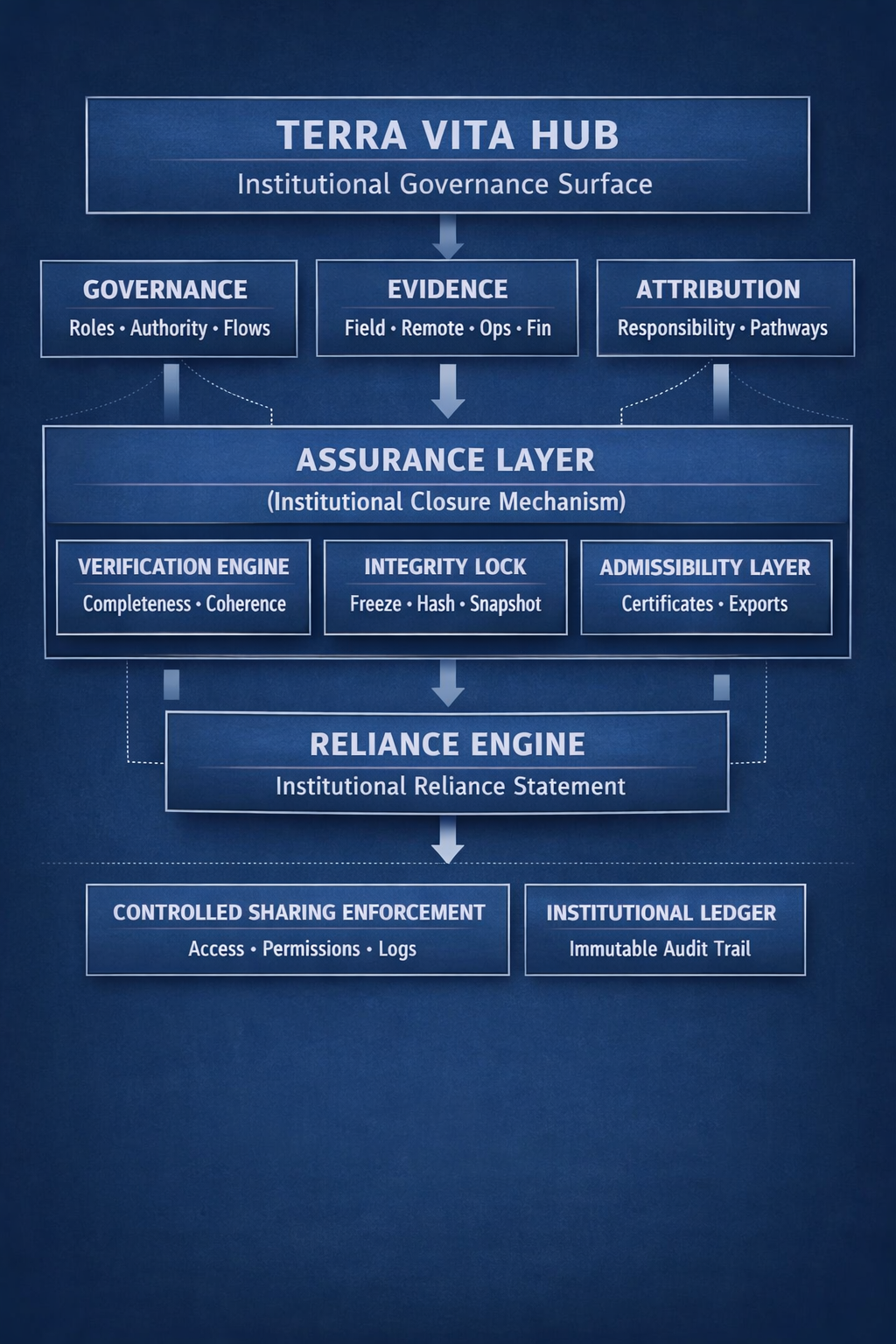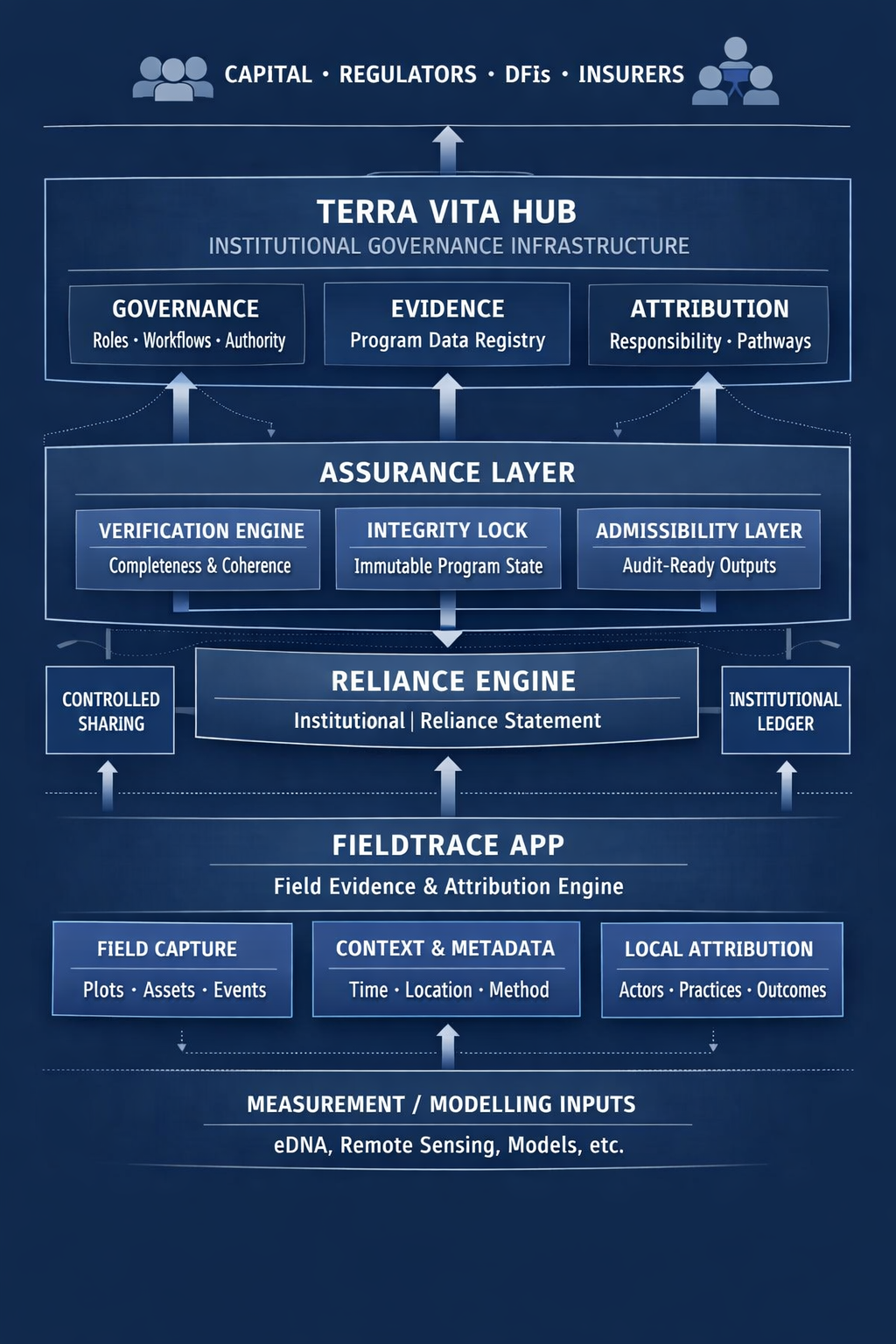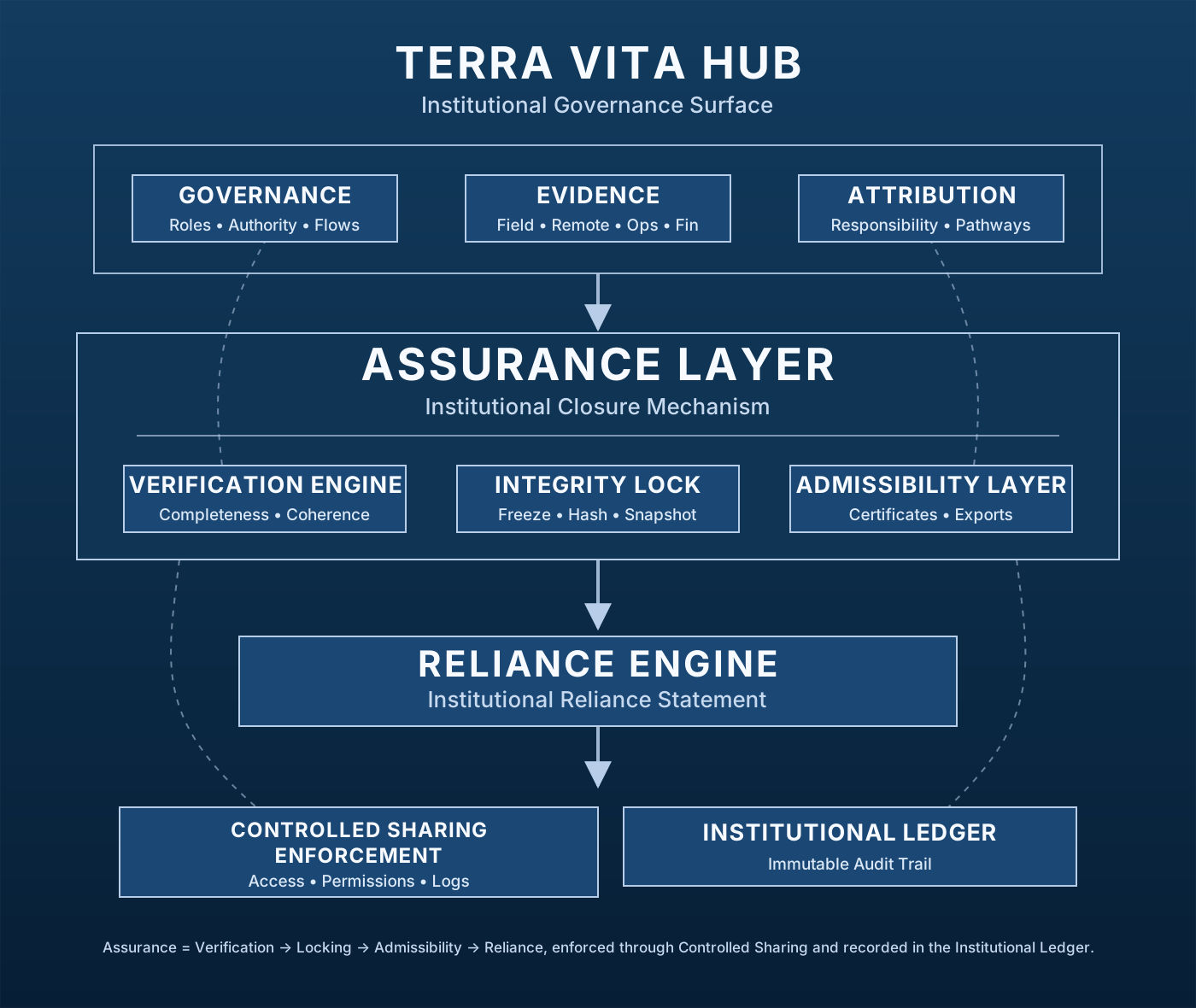
Material actions are attached to authorised users, roles, contexts, and conditions.
The Institutional Assurance Layer
How institutions verify, trust, and adopt Terra Vita Hub. The Institutional Assurance Layer explains how governance becomes testable: reviewer identity, evidence integrity, conditions, overrides, audit reconstruction, institutional memory, and cross-jurisdiction coherence remain connected under real-world pressure.
IAL proves that the governance spine holds under pressure, scale, and time.
Institutions do not only ask whether governance exists. They ask whether the governance chain can be verified when reviewers change, evidence is challenged, funding conditions are scrutinised, and auditors need to reconstruct the record later.
Evidence is treated as an institutional object with source, timing, submitter, programme context, review status, and decision linkage.
Reviewers approve, reject, escalate, or mark readiness with recorded conditions and rationale.
Exceptions are permitted only as governed events with named attribution, authority basis, scope, expiry, and audit timestamp.
Assurance primitives connect architecture to institutional trust.
| Primitive | What it answers | Public assurance route |
|---|---|---|
| Identity binding | Who acted, under what role, and in which programme context? | Reviewer accountability, role governance, and protected access boundaries. |
| Evidence integrity | Can the evidence behind a decision still be located, reviewed, and linked? | Evidence lineage, MRV attachment, export posture, and audit replayability. |
| Routing logic | Was the record routed through the right reviewer pathway? | Programme routing, workspace assignment, escalation matrix, and committee pack posture. |
| Auditability | Can the decision chain be reconstructed later? | Audit trail, reviewer rationale, timestamped events, and non-destructive history. |
| Override governance | Were exceptions named, justified, bounded, and visible? | Traceable override protocol, escalation posture, and follow-up conditions. |
| Institutional memory | Can a new official understand historical decisions without relying on informal memory? | Persistent decision context across personnel turnover, programmes, and jurisdictions. |
IAL gives each institution a clear way to test governance.
Test authorised reviewer access, national programme linkage, MRV traceability, committee-pack lineage, continuity, and sovereignty posture.
Test milestone-to-evidence linkage, safeguards conditions, release-readiness controls, override visibility, and portfolio oversight.
Test methodology linkage, indicator lineage, safeguards and eligibility visibility, and traceable reporting outputs.
Test chronology, reviewer identities, evidence changes, supersession, overrides, export linkage, and reconstruction completeness.
Minimum configuration for public-sector and DFI-grade assurance.
| Component | Minimum requirement |
|---|---|
| Identity binding | Named users attached to roles and material actions. |
| Evidence integrity | Evidence records linked to programme context and review status. |
| Routing logic | Defined review and escalation pathways. |
| Condition capture | Structured conditions attached to decisions. |
| Override protocol | Overrides recorded with rationale and authority basis. |
| Audit trail | Material actions preserved for reconstruction. |
| Export linkage | Committee and donor outputs traceable to governed evidence. |
| Authority boundary | Clear distinction between system support and institutional decision authority. |
Read the full Institutional Assurance Layer whitepaper.
The PDF below is public-facing and intended for institutional review. Record-level evidence, reviewer actions, live audit trails, access rows, committee packs, and data-room materials remain protected and role-bound.
Use the IRI Whitepaper as the third layer: reviewer oversight.
The Governance Spine controls the structure. The Institutional Assurance Layer preserves proof. The Institutional Review Index explains how reviewer behaviour, consistency, calibration, bias/divergence signals, and cross-programme comparability are governed without replacing human or sovereign authority.
Use the Governance Spine & Assurance Annexes as the control-evidence bridge.
The annex pack connects sovereignty, identity and access, Audit/RLS assurance, MRV attachment rules, and deployment architecture to the same governance spine that the IAL verifies.
Use IAL alongside the Governance Spine and Institutional Review Index.
Governance Architecture explains the controlled decision chain. The Institutional Assurance Layer explains how institutions verify that the chain actually holds under scrutiny.