Aquaculture Systems — Blue Governance Module
Aquaculture Systems
A governance and evidence module for climate-resilient coastal livelihoods
Aquaculture is a critical pillar of coastal resilience. When designed and governed well, it strengthens food security, restores ecological function, and creates stable livelihoods for coastal communities. The Aquaculture Systems module brings these interventions into a unified, auditable governance environment — ensuring they meet institutional standards for evidence, MRV, and funding readiness.
Terra Vita Hub structures aquaculture not as a production activity, but as a systems-level intervention that links ecosystems, communities, and markets. Programmes can define their aquaculture components, track milestones, integrate ecological and socio-economic indicators, and align with the requirements of governments, multilaterals, DFIs, and philanthropic funders.
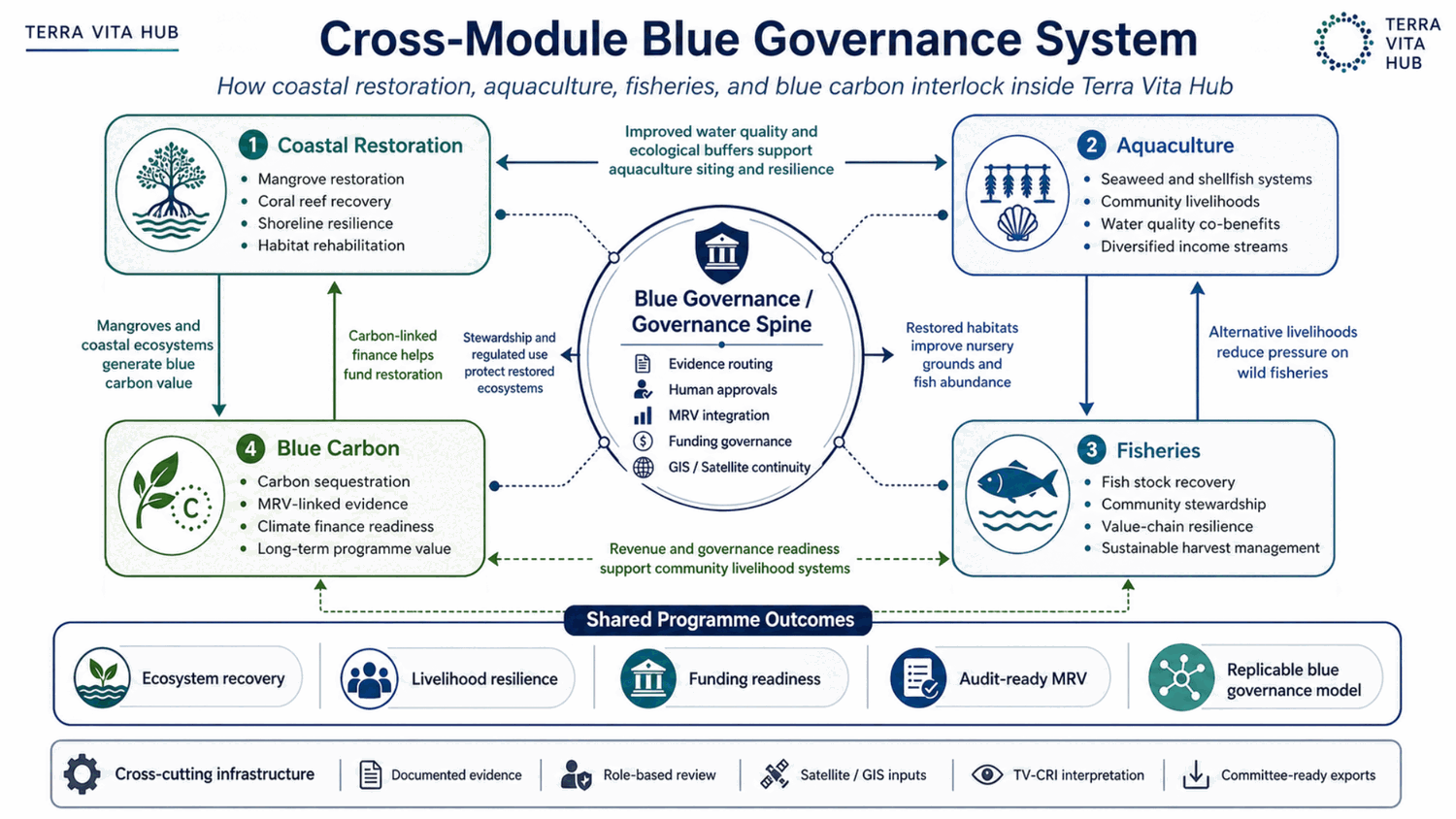
Cross-module Blue Governance System: how Aquaculture Systems connects with coastal restoration, fisheries governance, blue carbon, shared MRV, GIS / satellite continuity, and committee-ready governance outputs inside Terra Vita Hub.
What this module enables
Structured intervention design
Programmes can select and configure aquaculture interventions — from seaweed and shellfish farming to integrated multi-trophic systems and community-based micro-aquaculture units. Each intervention includes pre-defined governance logic, risk profiles, and evidence requirements.
Clear, auditable milestones
The module provides a full milestone pathway covering site preparation, infrastructure, stocking, production cycles, harvest, market integration, and ecological co-benefits. This ensures that aquaculture components are transparent, trackable, and aligned with funding tranches.
Integrated MRV for ecosystems and livelihoods
Aquaculture generates both ecological and socio-economic outcomes. The module captures water quality, biomass, biodiversity indicators, household income, cooperative performance, and gender/youth participation — all within a single MRV environment.
Evidence and compliance in one place
Programmes can upload water tests, stocking logs, harvest records, governance documents, training evidence, and environmental approvals. This creates a complete, institution-ready evidence trail for due-diligence and reporting.
Funding readiness for blue-economy programmes
The module automatically generates cost curves, risk assessments, governance compliance checks, and evidence completeness scores — enabling funders to evaluate aquaculture components with clarity and confidence.
Governance-module positioning
Aquaculture sits inside the Blue Governance Suite as a module alongside coastal restoration, fisheries governance, and blue carbon. Marine ecosystem evidence and marine spatial planning act as shared evidence and spatial layers — not competing sector labels.
Intervention templates
Selectable programme components
Each template is designed to carry pre-defined governance logic, milestones, risk considerations, and evidence requirements.
Seaweed Farming
Kelp, Ulva, Gracilaria, carbon/nutrient-removal indicators, harvest evidence, and market linkage.
Shellfish Aquaculture
Oysters, mussels, clams, water-quality co-benefits, biosecurity, and harvest traceability.
Sea Cucumber Farming
Benthic-health linkage, juvenile procurement records, growth monitoring, and market integration.
Integrated Multi-Trophic Aquaculture
Multi-species system design, ecological balancing logic, production-cycle MRV, and co-benefit tracking.
Land-based Aquaculture
Ponds, RAS, brackish systems, water-use controls, input tracking, disease surveillance, and production records.
Community-based Micro-Aquaculture Units
Household-scale livelihood units, training evidence, cooperative governance, and income records.
Women-led Aquaculture Cooperatives
Governance participation, training attendance, cooperative performance, income tracking, and market stability.
Climate-Resilient Species Pilots
Species risk profiles, suitability assessments, survival rates, adaptation value, and evidence-gated scaling.
Milestone logic
Aligned with the Funding Governance Workspace
1. Site & system preparation
2. Infrastructure & inputs
3. Production cycle
4. Post-harvest & market integration
5. Ecological co-benefits
Phase 1 — Site & System Preparation
- Site identification and suitability assessment
- Water quality baseline
- Species selection and risk profile
- Community governance structure established
- Environmental approvals, where required
Phase 2 — Infrastructure & Inputs
- Installation of lines, rafts, ponds, cages, or RAS systems
- Seed or juvenile procurement
- Biosecurity plan
- Training of community groups
Phase 3 — Production Cycle
- Stocking
- Growth monitoring
- Water quality tracking
- Disease surveillance
- Harvest cycle
Phase 4 — Post-Harvest & Market Integration
- Processing
- Cold chain, where relevant
- Market linkage
- Income tracking
Phase 5 — Ecological Co-Benefits
- Water quality improvement
- Habitat enhancement
- Biodiversity indicators
- Carbon or nutrient removal, where applicable
Evidence, MRV, and funding readiness
Evidence requirements
- Water quality tests
- Species health logs
- Stocking records
- Harvest logs
- Community governance meeting minutes
- Training attendance sheets
- Photos, GPS points, and satellite snapshots
- Market receipts and income records
- Environmental compliance documents
MRV indicators
- Biomass produced, survival rate, feed conversion, and harvest cycles
- Water clarity, nitrogen/phosphorus reduction, benthic health, biodiversity presence, and carbon sequestration where relevant
- Household income, women/youth participation, cooperative performance, and market stability
Funding readiness logic
- Cost curves
- Risk profiles
- Governance compliance
- Evidence completeness
- MRV sufficiency
- Tranche-release readiness
Why aquaculture belongs in the Blue Governance Suite
Aquaculture is central to the blue economy. It supports climate resilience, improves water quality, restores ecological function, and provides stable livelihoods for coastal communities. By integrating aquaculture into the Blue Governance Suite, Terra Vita Hub offers governments and funders a complete governance infrastructure for coastal and marine systems — from restoration and fisheries governance to blue carbon and sustainable aquaculture.
Connected live Blue workspaces
Aquaculture remains part of the shared coastal, fisheries and blue-carbon operating environment
Aquaculture Systems now links directly to the live Coastal Restoration, Fisheries Governance and Blue Carbon workspaces, plus the institutional reporting layer for donor, DFI and UN-style review.
Homepage governance alignment
Aquaculture Systems inherits the Terra Vita governance spine.
This module reflects the homepage position: Terra Vita Hub is governance infrastructure, not a dashboard. Evidence intake, reviewer action, MRV attachment, escalation, audit reconstruction, and export posture remain connected inside one governed decision environment.
Evidence intakeReviewer actionMRV attachmentEscalationAudit reconstructionExport posture