Protected governance → resistance routing
Reviewer Accountability & Resistance Routing
This protected note explains how the Hub makes institutional resistance observable, attributable, routable, and accountable without turning it into interpersonal escalation or changing live business logic.
Reviewer accountability
Make resistance visible in the same way evidence is visible.
Most systems treat resistance as noise. The Hub treats resistance as attributed governance data: visible, timestamped, routed, and resolvable inside the same governed chain as evidence.
- A reviewer cannot stall silently; delay is timestamped.
- A reviewer cannot reinterpret evidence privately; interpretation is logged.
- A reviewer cannot block without a reason; the reason becomes part of the record.
- A reviewer cannot route around the spine; actions must remain inside the governed chain.
Visibility is the first containment mechanism. People behave differently when resistance is observable.
Documentation-only boundary
This page defines the governance model, not new live logic.
The resistance lifecycle described here is a protected design and donor-readiness note. It does not add workflow automation, alter auth, modify RLS, change schema, execute SQL, or connect to Netlify Functions.
Governance resistance diagram
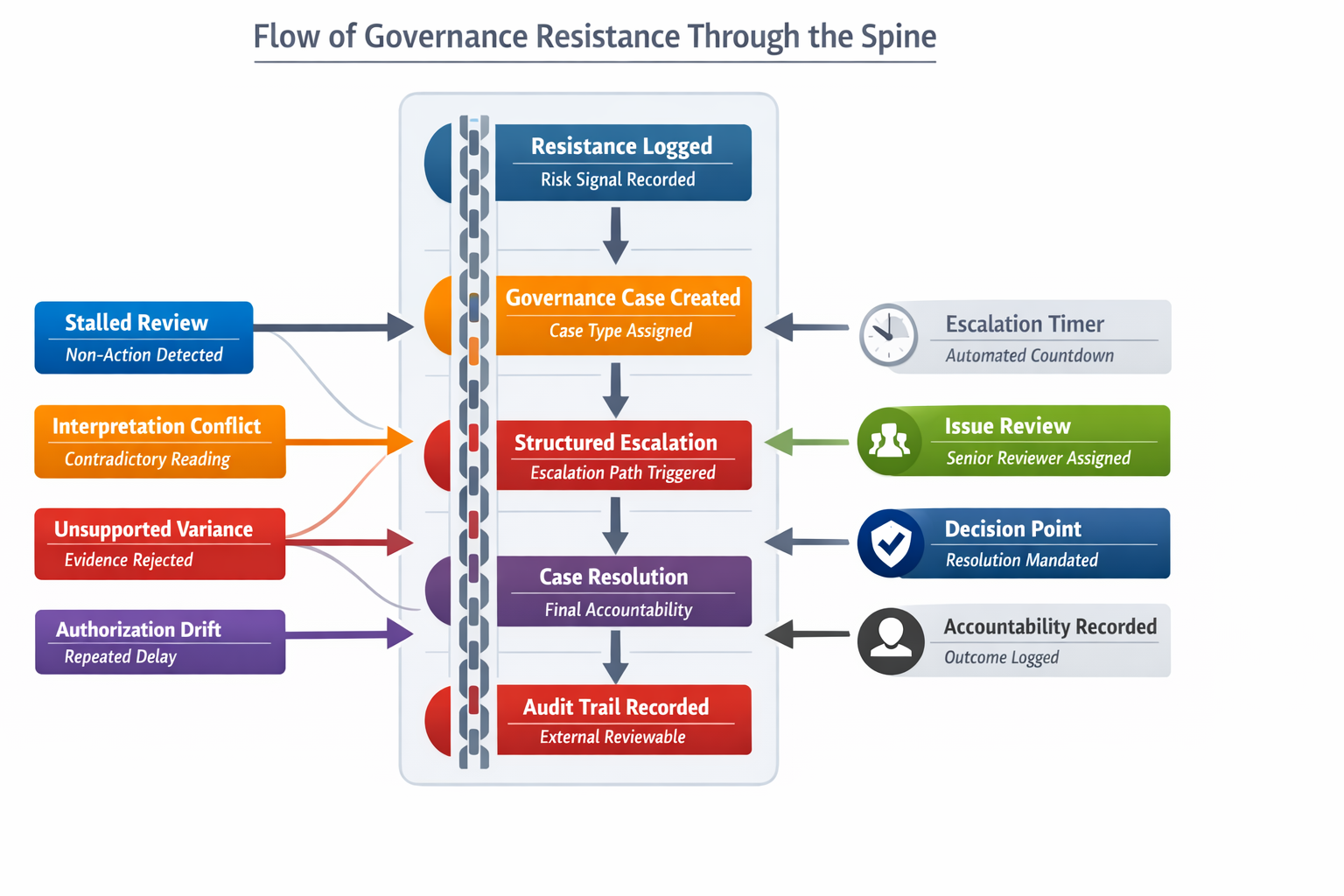
Flow of Governance Resistance Through the Spine
The supplied diagram is attached here as the review visual for the resistance-governance model.
Lifecycle definition
Resistance becomes a governance object with a defined lifecycle.
In the Hub model, resistance is not a vibe. It is classified as a case type with a trigger condition, reviewer of record, time-bound escalation path, resolution requirement, and final accountability assignment.
Stalled reviewTrigger: non-action or missed review window. Reviewer of record remains attached. Escalation timer starts after the defined threshold.
Interpretation conflictTrigger: contradictory reading of evidence or methodology. The competing interpretation is attributed and routed for issue review.
Unsupported varianceTrigger: evidence rejection without a stated basis. The rejection basis must be supplied, reviewed, or resolved.
Authorization driftTrigger: repeated discretionary delay or route deviation. Escalation assigns ownership for returning the case to the governed chain.
Structured escalation
Escalation is procedural, not interpersonal.
In live environments, escalation often moves into side channels, private meetings, political intermediaries, or informal requests. The Hub replaces that pattern with automated timers, role-based routes, evidence-attached escalation packets, and no ability to escalate outside the spine.
| Escalation element | Governance function | Containment effect |
|---|
| Automated timer | Starts from the resistance trigger or missed action point. | Pressure cannot be applied to quietly wait longer. |
| Role-based route | Routes to the defined senior reviewer, committee owner, or institutional role. | Personality and hierarchy are removed from escalation selection. |
| Evidence-attached packet | Carries the record, interpretation, rejection basis, timestamps, and reviewer history. | Escalation remains reviewable and cannot detach from evidence. |
| Spine-only action | Keeps the next action inside the governed chain. | Side-channel resolution cannot erase the accountability trail. |
Bounded discretion
Reviewer discretion remains, but it is bounded.
- Reviewers can interpret, but must attribute their interpretation.
- Reviewers can reject, but must justify the rejection.
- Reviewers can delay, but the delay becomes visible and time-bound.
- Reviewers can escalate, but only through defined routes.
Bounded discretion is the only way reviewer accountability survives operational pressure.
Pressure-resilient design
Accountability must hold during deployment pressure.
- Reviewer actions are irreversible and attributable.
- Every action is timestamped and sequence-locked.
- Conflicts generate governance signals, not interpersonal conflict.
- Escalation is automatic, not discretionary.
- The audit trail is externalizable for funders, auditors, and multilaterals.
Non-obvious insight
Resistance becomes predictable once it is routable.
Once resistance is routable, it can be measured, anticipated, used to diagnose institutional misalignment, used to calibrate incentives, and used to strengthen the governance spine itself. This is where the Hub stops being a workflow tool and becomes institutional infrastructure.